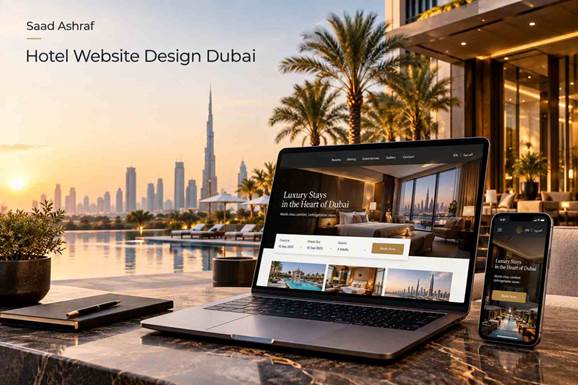
A successful hotel website design in Dubai needs a combination of luxuryvisuals with flawless booking systems, mobile responsiveness, localised multi-currency and multilingual features that help convert local and international visitors into direct bookings. With these factors, a hotel website design acts as a digital reception desk, booking channel, concierge, and brand experience altogether. This article serves as a complete guide to what a modern hospitality website in Dubai looks like, how bookings work, what hospitality businesses should know when they hire a designer, and how much budget you should have to invest in hotel website design.
Why hotel website design is important in Dubai
Dubai’s hospitality industry includes premium resorts, international hotel chains, business hotels, boutique properties, serviced apartments, and holiday stays. The Dubai Department of Economy and Tourism (DET) maintains an official hotel classification system for Dubai-based hotel establishments, reflecting the structured nature of the local hospitality sector.
A website is one of the few digital platforms that provides a complete guest experience. You can use third-party platforms, but a website can provide greater control over the following things:
- Brand presentation
- Room and package information
- Direct booking journeys
- Special offers
- Guest communication
- Hotel policies
- Dining and facilities information
- Local destination content
- Enquiry generation
- Customer experience
Don’t move forward with investing in a visually appealing website; invest in a platform that attracts the right guests to visit and book your property.
How to know if your hotel website is good
A good website is capable of answering guests’ queries instantly. The questions can be:
- What is the location of the hotel?
- What does the hotel look like?
- Which room is good for me?
- What is the cost of the room?
- What will be included?
- What facilities will I receive?
- Can I book securely?
A high-converting website has the following factors:
- Appealing visual presentation.
- Easy-to-navigate structure.
- Mobile responsiveness.
- Booking functionality.
- Clear and trustworthy information.
For example, your website has a beautiful homepage but shows a confusing booking system, or you have a fast website, but guests don’t understand the value of the location. Both scenarios will be useless. Hence, a booking website design in Dubai must combine emotion and usability. You can use premium visuals to show hospitality, but you need other features too to help visitors make the right decision.
What features does a good hotel website design consist of
The features that must be included in modern hotel website design in Dubai are:
Mobile responsive design
Most searches related to hotels and accommodations are done through smartphones and tablets while people are traveling, commuting, comparing destinations, etc. Hence, your website must perform well on every type of device. A responsive design will offer:
- Easy-to-tap buttons
- Simple date selection
- Readable room information
- Fast-loading images
- Mobile-friendly booking forms
- Sticky or highly visible booking CTAs
- Easy access to phone and WhatsApp
- Simple navigation
After developing the website, test the appearance and functionality on a good smartphone rather than assuming that responsive design will work best anyhow.
Install booking engine
A website design should make it easy for visitors to book immediately after finalising the accommodation. The integrated booking system must help to:
- Select check-in and check-out dates
- Enter the number of guests
- View available rooms
- Compare rates
- Review room details
- See applicable policies
- Select offers or packages
- Complete payment securely
- Receive booking confirmation
Furthermore, the booking system should align with the website design. Sudden changes to the user experience can erode trust. Before you hire the booking technology provider, test the service on a mobile device. Verify that the steps are easy to understand and that everything is clear for the guests.
High-quality photos and videos
To help guide visitors and encourage them to book a reservation, make sure to add visuals and videos that are professional and high quality. This is because they can’t visit to make a reservation and will totally rely on visuals. The professional photography should include:
- Exterior
- Lobby
- Rooms
- Bathrooms
- Views
- Swimming pool
- Restaurants
- Spa
- Fitness facilities
- Meeting spaces
- Events
- Nearby attractions
That doesn’t mean using decorative images, but rather images that answer user queries promptly. For example, instead of showing three similar bedroom photographs, use different images that explain the room’s layout, view, bathroom, workspace, and key features.
You can also integrate short clips, virtual tours, or carefully selected interactive galleries if that increases decision-making.
Clear room and suite pages
Every room must have its own detailed page when its components set it apart from the rest. A special room page typically includes:
- Room name
- Room size
- Bed configuration
- Maximum occupancy
- View
- Amenities
- Accessible features where applicable
- Photography
- Relevant policies
- Available packages
- Pricing or a direct route to live rates
- “Book Now” CTA
The booking action must be present on the same page so that visitors don’t have to leave the homepage only to make the booking. All the information must be present on the room page so that users don’t have to make an effort to explore the website to find it and make the reservation.
What should be the structure of an ideal hotel website
A professional and high-performing hotel website design must look like the one mentioned in the table below:
| Page | Primary purpose |
| Home | Communicate the property and drive bookings |
| Rooms & Suites | Help guests compare accommodation |
| Offers | Promote packages and special rates |
| Dining | Showcase restaurants, bars and dining experiences |
| Facilities | Explain amenities and services |
| Experiences | Promote activities and destination experiences |
| Meetings & Events | Generate event and corporate enquiries |
| About | Communicate the property’s identity |
| Location | Help guests understand accessibility and nearby attractions |
| Gallery | Provide visual proof of the experience |
| Contact | Make communication easy |
| Book Now | Provide the reservation journey |
This is the tentative structure that a hotel website design should have, but the exact structure and design depend on the size and type of the property. For example, A boutique hotel website might require fewer pages compared to a resort that needs specific pages for restaurants, spa services, weddings, events, activities, accommodation types, and multiple properties.
Homepage must be designed according to guests’ expectations
Rather than making a homepage as the digital poster for the hotel, craft it in a way that can make easy for guests to receive the information they need. The best homepage can include the following sections in the right sequence:
Hero section
It will quickly convey the following information about the hotel:
- Hotel name
- Location
- Property positioning
- Key visual
- Primary booking CTA
For example:
Hotel name and location: Luxury beachfront resort in Dubai
Property positioning: Stay steps from the Arabian Gulf with spacious rooms, dining, and resort experiences.
CTA: Check Availability
Booking and search module
A direct way is provided for visitors to fill in their respective dates and personal information.
Rooms
Main room categories are presented here with clear links to the detailed page.
Offers
Relevant packages are presented, avoiding promotional information that can distract users from making the booking.
Dining and facilities
It will help visitors know that they will be offered these facilities, including dining protocols, and not just the room.
Experiences and the location
It will show visitors what they can expect in the hotel surroundings and how the location will fit their needs.
Reviews and trust signals
Use authentic and original reviews that can enhance the trust of new visitors.
Hotel website design needs bilingual structure
Hospitality businesses in Dubai need to consider bilingual design logically. A hotel may serve residents, Arabic-speaking guests, international tourists, expatriates, business travellers, and families from different markets. Using an Arabic and English website design doesn’t mean that the website just translates English word-for-word. In fact, the Arabic language requires a right-to-left layout that needs special care for:
- Navigation
- Buttons
- Forms
- Menus
- Typography
- Icons
- Alignment
- Booking interfaces
- Mobile layouts
Switching from one language to the other must be continuous and obvious. The translation must consider hospitality terminology and cultural context rather than relying on automatic translation. If your hotel website serves both languages, design it with a bilingual structure from scratch rather than adding Arabic later.
Arabic support introduces another issue that is easy to underestimate. A common failure in bilingual hotel websites is treating RTL as simply “English with the layout flipped.” For example, a hotel may correctly move the Arabic navigation to the right but leave a “Next” arrow pointing in the English direction, while a phone number such as +971 4 XXX XXXX becomes visually confusing inside an Arabic sentence. These are not translation errors; they are bidirectional interface and content problems. Current RTL implementation guidance specifically identifies directional icons, phone numbers, prices, Latin brand names, and mixed Arabic-English content as areas requiring separate handling.
Website speed and performance are crucial in hotel website design
Premium and high-quality visuals are necessary in hotel website design, but they can make the website slower. For this reason, you need to keep an eye on the website speed and performance from scratch. You can enhance website speed by:
- Compressing images
- Using modern image formats where appropriate
- Serving correctly sized images
- Lazy-loading non-critical media
- Reducing unnecessary scripts
- Limiting excessive animation
- Using reliable hosting
- Testing third-party booking integrations
- Monitoring Core Web Vitals and real-world performance
Don’t remove all the high-quality visuals from the website to enhance speed, but keep the ones that help to enhance the guest experience and optimise them properly.
How direct communication through WhatsApp can benefit
Sometimes users can ask simple questions like:
- Is a particular room available?
- Do you offer airport transfers?
- Is breakfast included?
- Can I arrange an early check-in?
- Do you accommodate large families?
- Can I book a private event?
That doesn’t require filling out a form, but rather a direct conversation. Here, WhatsApp helps businesses to connect directly and efficiently. But WhatsApp shouldn’t be the only channel to connect. Visitors who need to book immediately must be provided with a clear route to the booking engine. WhatsApp can be helpful when visitors need pre-booking questions, concierge enquiries, group requests, event enquiries, and customer support.
Which is the best way: direct booking or third-party booking platforms
Third-party booking platforms can be helpful, but a hotel’s own website can provide a direct booking channel, which is more beneficial. The table below shows a quick comparison between the two options:
| Direct hotel website | Third-party platform |
| Full control over brand presentation | Platform controls much of the presentation |
| Direct guest relationship | Relationship mediated by platform |
| Custom offers and packages | Platform rules may apply |
| First-party website experience | Standardized booking experience |
| Greater control over content | Listing format is constrained |
| Direct communication opportunities | Platform communication tools vary |
Third-party integration is not necessarily a bad option. You can work with it too, besides your own website, by making your website the direct way to book reservations.
How personalisation can be incorporated as a smart hotel experience
Dubai’s tourism and hospitality industry is moving forward with digital guest experiences. For this reason, in December 2025, DET announced contactless hotel check-in technology that can allow participating guests to bypass traditional front-desk check-in after completing the required identification and biometric process. This innovation has evolved website development from a simple brochure to a sales engine and booking platform.
Accessibility and inclusive design
A hotel website must be useful for as many types of visitors as possible. For this purpose, consider the following:
- Bilingual & RTL integrity
- Perceivable content
- Operable navigation
- Robust code structure
- Accessible room inventories
- Cognitive clarity
- Mobile optimization
Hence, keep an eye on the accessibility features during the design and development of the website rather than considering them an afterthought.
What is the cost of hotel website design in Dubai
There is no standard price of hotel website design in Dubai because it depends on the type and size of the website. A simple website with several informational pages will cost less compared to a large hotel website that includes multilingual content, a booking engine, custom UX, multiple properties, integrations, and advanced functionality. Evaluate the scope of your website to determine the cost of website development. Never consider the price based on the number of pages only. While hiring the developer, compare the proposals that does the cost includes the following:
- UX/UI design
- Development
- CMS
- Booking integration
- Arabic/English implementation
- SEO setup
- Copywriting
- Photography or video
- Hosting
- Security
- Analytics
- Testing
- Training
- Post-launch maintenance
If you choose a low quote, remember you might have to pay extra afterwards, as it might lack some important elements.
How to choose the best hotel website designer in Dubai
The designer must go beyond creating an attractive homepage. Ask about the following:
- Have you worked on hospitality or booking-focused websites?
- Can you demonstrate responsive websites on real mobile devices?
- How will the booking engine integrate with the design?
- Can you support Arabic and RTL layouts if required?
- How will the website be structured for SEO?
- Who will provide the content and photography?
- What CMS will the hotel use?
- Which integrations are included?
- What happens after launch?
- Who owns the website, domain, design files, and content?
Evaluate their portfolio on a functional basis rather than only aesthetics.
What common design mistakes you must be aware of
- Hiding the booking button; guests should not have to make an effort to reach the booking.
- Using beautiful and large images- they can enhance the story but can slow the website’s performance.
- Making the website desktop-first- it can cause trouble when scrolled on a smartphone.
- Treating the booking engine as an afterthought- it is the commercially important part of the website.
- Providing incomplete room information- detailed information is required to choose between the two rooms.
- Extra animations- animations should facilitate bookings, not distract the user from it.
- Ignoring Arabic users- if bilingual support is needed in the project, it should be considered from scratch.
- Depending on third-party platforms, a strong online presence is necessary even if the hotel is using third-party platforms.
FAQs:
- Should the hotel website integrate bilingual design?
If the target audience is Arabic- and English-speaking, then you should consider bilingual website design from the beginning.
- Do I need a separate mobile app?
Not necessarily. A well-designed and responsive website can be enough. A separate mobile app is ideal for larger resorts and hotels that have frequent repeat guests and need more advanced features.
- What time is required to build a hotel website?
A professional hotel website takes 4 to 12 weeks. The exact timeline depends on whether you need a basic brochure website or an advanced booking portal.
- Can WhatsApp be integrated into a hotel website?
Yes, it can be integrated, but it shouldn’t replace an online booking system.
- How does a hotel website integrate with an existing PMS?
A hotel website typically connects to an existing Property Management System (PMS) through an API or a booking-engine integration.
Key takeaways
A strong and impactful hotel website design in Dubai needs to be more than just attractive visuals. The design must communicate the value of the property, makes easier for guests to make the right decision, be mobile-friendly, easy to navigate, and make the booking process quicker and easier. For better results in Dubai’s competitive landscape, the website should be crafted around visitors’ journey rather than just creating an appealing homepage. If you plan to create a website from scratch or even redevelop an existing one, make sure to connect with an experienced designer who is an expert in UX, responsive design, SEO, and installations, and who can transform the website into a reliable booking and communication channel rather than simply treating the website as an online brochure.