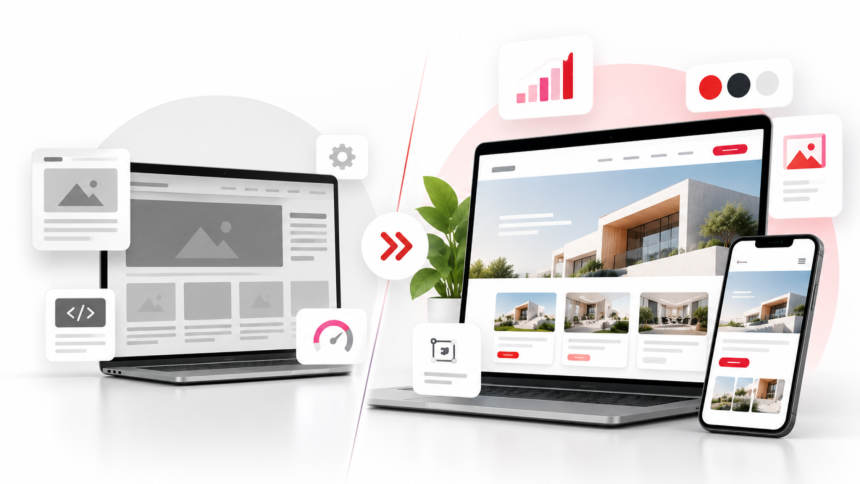
Redesign or rebuild? That is the question every Dubai business with an old website faces eventually. Both fix a website that no longer works. But they are not the same thing. This guide compares website redesign vs. rebuild, heading by heading, so you can see both sides of every point before you choose.
A redesign keeps your site and improves it. A rebuild starts fresh. The right choice depends on your site’s age, its technology, your budget, and your goals. When it comes to website redesign, Dubai businesses usually ask the same question: which option wastes less money? The honest answer is, it depends on what is wrong with your site.
What Redesign and Rebuild Actually Mean
A redesign keeps your website’s foundation and changes how it looks and works. Same platform, same content, new design, better layout, clearer pages. Think of it as renovating a house: the structure stays, the rooms get better. A redesign makes sense when the site works but looks old, feels slow, or converts poorly.
A rebuild starts from scratch. New platform, new code, new structure, sometimes new content too. Think of it as demolishing the house and building a new one. A rebuild makes sense when the technology is too old, the site breaks often, or the structure cannot support what your business needs now.
Cost: What Each Option Really Costs
A redesign usually costs less, because you keep the foundation. The platform, the content, the basic structure, all of it stays. You pay for design, layout, and improvements, not for starting over. For a small business with a working site, that is real money saved. But watch out: a redesign on a broken foundation can cost more in fixes later.
A rebuild usually costs more upfront, because everything is new. New platform, new code, new design, new testing. The bill is bigger, and it should be, because you are buying a fresh start. But a rebuild can save money over time, because a modern site needs less fixing. Compare the total cost over two years, not just the launch price.
Time: How Long Each Takes
A site’s redesign typically takes less time. Most website redesign Dubai projects can be completed within several weeks, not several months, as the basic structure of the site is present. This includes design, layout, content updates, testing and launching. During this process, the current version of the site remains operational, allowing you to continue operating your business without interruption. If you require immediate results for your company, then time is of the essence.
Rebuilding your website can take months rather than weeks. This is due to the fact that everything has to be created from scratch. You will have to create a plan for what you want your new site to look like; then you will have to design the new site; next you will have to develop the new site; after that you will have to move all of your existing content over to the new site; once that’s done, you’ll need to test the new site; finally, you’ll be able to launch your new site. During the entire time that you are working on the new site, your current site will remain active.
Design and User Experience
A redesign makes the site look and feel better. It has a cleaner look, easier navigation and clearer actions. It feels contemporary but won’t confuse past users since the structure of the site will remain the same. This is a big plus: your current customers don’t need to relearn how to use your site.
Rebuilding provides you with total control over the design of your site. There are no limitations imposed by an existing layout or compromised pages that were developed several years ago. You will have the opportunity to develop a perfect user experience from the beginning, using mobile-first techniques, optimizing for speed, and designing the entire site with the needs of your audience in mind. However, while rebuilding offers you total freedom to create the site of your dreams, that freedom comes at a price. Each choice you make is a first-time decision. First-time decisions require time to determine what works best for your users.
Performance, SEO, and Technical Health
A redesign can fix speed and SEO without touching the foundation. Compress the images, clean the code, fix the broken links, improve the page titles. Test your speed honestly with PageSpeed Insights, Google’s free tool that scores your pages and tells you exactly what to fix.
A rebuild fixes technical problems a redesign cannot touch. Old code, slow servers, security holes, a platform nobody supports anymore. A fresh build means modern code, fast loading, and clean SEO from day one. But migration is risky: every URL, every page, every ranking must move correctly, or you lose search traffic.
Content and Migration Risks
A redesign keeps your content mostly as it is. Pages stay where they are, URLs stay the same, search rankings stay safe. You update the words and images that need it, and leave the rest alone. That is the low-risk option. The risk is small, because the site never really moves.
A rebuild moves everything. Content must be reviewed, rewritten, or migrated page by page. URLs change, redirects must be perfect, and one missed redirect can cost you search traffic for months. Migration is the riskiest part of a rebuild, and it needs a careful plan. Budget time for it, because it always takes longer than expected. Google’s sitemap guide explains how to build a sitemap that tells search engines which pages matter, so your rebuilt site gets found faster.
Which Option Fits Your Business?
Choose a redesign when your site works but looks old, when the platform is modern, and when your budget is tight. An experienced website designer Dubai businesses trust can help you decide whether a redesign is enough. This is the option most businesses take when the foundation is solid.
When you have an old technology stack, when the site has frequent breakdowns, or when the current architecture can no longer meet your business requirements today, then choose to do a rebuild. A rebuild is also the correct choice when a redesign will merely fix problems that will continue to occur. Rebuilds are more expensive and take longer than a redesign, but they provide a clean slate that will last for years.
Making the Decision
Begin by making an objective evaluation of your current website. What age is the technology that supports your website? Does your website go down frequently? How fast does your website load? Do users convert at a high rate on your website? If most of these questions have positive responses, then you can probably redesign your website. You can repair issues with your website, strengthen the areas where it is weak, and launch.
The most appropriate option when most of the answers are “bad” is to likely have to do a rewrite. The current platform is old, continually experiencing issues/bugs, pages load slowly, and conversions are low. These indicate that the existing foundation is no longer working. While a rewrite will cost more and take more time than fixing the current platform, it will stop the endless patching process. When making this decision, use facts rather than fear to determine which course of action is going to be best for your company over the next five years.
After the Decision: What Happens Next?
After the redesign, most of your time will be spent on making updates. Once the new design has launched and your content has been updated, you can begin testing the site’s performance (speed). Your site will remain active during this process, which means that the launch of the new site will most likely go unnoticed by many people. You should watch your metrics for at least one month after the launch to determine if there were improvements in those areas. If you address any problems that arise during the initial launch phase quickly, you will start seeing the benefits of the redesign sooner rather than later.
At this point in the process of rebuilding your website, you are mostly watching. Your new site has been launched; you check for the redirecting of traffic from the old site to the new one; you monitor the search engine results. It takes patience during the first month for search engines to begin to trust the new pages. You can track your daily traffic numbers, make sure to find and fix broken links quickly, and continue to use the best content from your old site on the new site.
Quick Comparison at a Glance
Here is the whole comparison in one place, so you can decide at a glance.
| Point | Redesign | Rebuild |
| Cost | Lower | Higher |
| Time | Weeks | Months |
| Design | Improves what exists | Built from scratch |
| Speed and SEO | Fixes speed, keeps rankings | Modern code, migration risk |
| Content | Mostly stays | Moves, needs a plan |
| Best for | Solid foundation | Old technology |
FAQs
What is the difference between a redesign and a rebuild?
A redesign keeps your site’s foundation and improves how it looks and works. A rebuild starts from scratch with a new platform, new code, and new structure.
Which is cheaper, a redesign or a rebuild?
A redesign is usually cheaper because you keep the foundation. A rebuild costs more upfront, but it can save money over time because a modern site needs less fixing.
How long does a redesign take?
Usually a few weeks, because the foundation already exists. A rebuild takes months, because everything is built from scratch.
Will a rebuild hurt my SEO?
It can, if migration is careless. Every URL must redirect correctly, or you lose search traffic. A careful plan and proper redirects protect your rankings.
Can I redesign my site in phases?
Yes. Many businesses redesign page by page, starting with the homepage and the pages that bring the most leads. That spreads the cost and the risk.
How do I know which option my business needs?
Audit your current site honestly. If the platform is modern and the site mostly works, redesign. If the technology is old and the site keeps breaking, rebuild.
Does a rebuild always mean a new design?
Usually yes, because a rebuild starts from scratch. But you can keep the old design’s best parts, the colors, the tone, the pages that work, and rebuild the rest.
Conclusion
Website redesign vs rebuild: the choice comes down to your site’s age, technology, budget, and goals. A redesign is faster, cheaper, and safer when the foundation is solid. A rebuild is the honest choice when the foundation has failed.
Start with an honest audit today. Check the platform, the speed, the conversions. Then choose the option that serves your business for the next five years, not just the next five weeks. And once you choose, commit to it fully. Half a redesign and half a rebuild is the most expensive option of all. A decision made on facts beats a decision made on fear, every time.