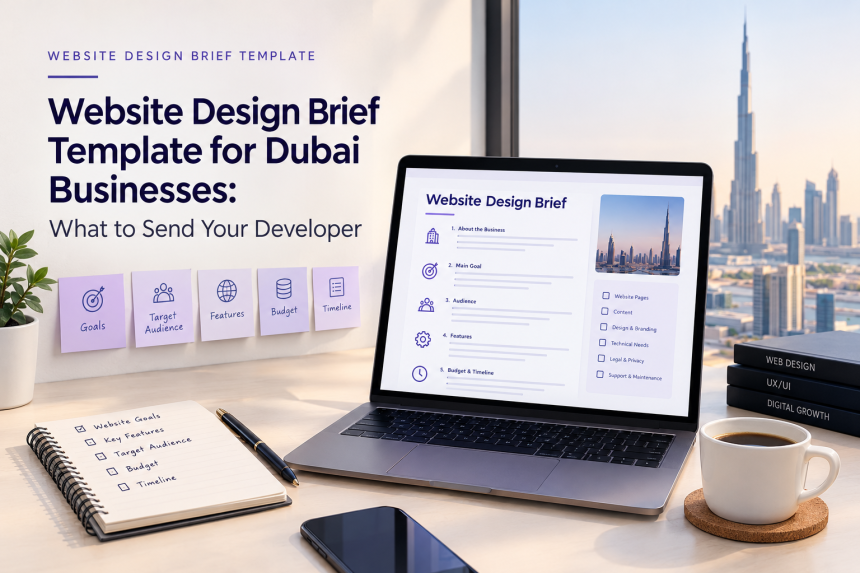
If you’re about to hire someone to build your website, the most useful thing you can send them first is a website design brief. The document is usually a short one, consisting of two or four pages. It describes the purpose of the website, its target audience, goals and objectives, and budget requirements.
However, the companies registered in Dubai have to include specific requirements: Arabic content, regional payment methods, licenses, and data privacy compliance. Otherwise, the project cost may be significantly different from the one you are going to sign in the contract.
There’s a ready-to-copy website brief template further down. First, a quick look at why it’s worth an afternoon of your time.
Why Bother Writing a Brief?
Picture a dental clinic in Al Barsha asking three designers for “a new website.” The first designer quotes for five English pages. The second assumes online booking and a full Arabic version. The third adds a logo refresh because the old one looked dated. That’s three quotes for three different projects, and no fair way to compare them.
A web design brief fixes that. Everyone prices the same website project requirements, so the gaps between quotes reflect real differences in cost, timeline and approach. Months later, when someone on your team asks “can we just add a careers page?”, you’ll have a document showing whether that was ever part of the deal.
It also pushes your own team to decide things early. Who’s writing the Arabic copy? Who signs off on the design? Someone will ask these questions eventually, and week one is the cheapest time to answer them.
Sort Out Three Things First
Decide what this website is primarily for. It could be for making phone calls, WhatsApp chats, bookings, online sales, or just to look good when bidding for contracts. You are most likely going to want more than one.
Then think about money. Keep your range between AED 8,000 and 12,000. It lets the developer suggest something that fits what you can actually spend.
The Template
Copy this into a Word file or Google Doc and fill in whatever you can. If you don’t know something yet, write “not sure” and keep going. A good developer will help with the blanks. They just need to know where the blanks are.
WEBSITE DESIGN BRIEF
1. ABOUT THE BUSINESS
⦁ Business name (as on trade licence):
⦁ Licensed in (mainland / free zone name / DIFC / ADGM):
⦁ What we sell, in two or three sentences:
⦁ Where our customers are (Dubai / UAE / GCC):
⦁ Competitor websites:
2. MAIN GOAL
⦁ The one action we want visitors to take:
⦁ How we’ll know it’s working after three months:
⦁ Current website (if any) and what’s wrong with it:
3. AUDIENCE
⦁ Who our customers are:
⦁ Languages: English / Arabic / both
⦁ How they find us (Google, Instagram, referrals, ads):
⦁ Mostly on mobile or desktop?
4. PAGES
⦁ Pages we need:
⦁ Pages that need Arabic versions:
⦁ Landing pages for ads:
5. CONTENT
⦁ Who writes the English copy:
⦁ Who writes or translates the Arabic:
⦁ Logo, brand guide, photos and videos we already have:
⦁ Anything we still need (photo shoot, stock images):
6. FEATURES
⦁ Forms / WhatsApp button / click-to-call:
⦁ Booking system:
⦁ Online payments and preferred gateway:
⦁ Instalment payments (e.g. Tabby, Tamara):
⦁ CRM or email tool:
⦁ Maps, Google Business Profile, other links:
7. LOOK AND FEEL
⦁ Brand colours and fonts:
⦁ Three websites we like, and what we like about each:
⦁ Websites we dislike, and why:
⦁ How the site should feel (a few words):
8. DOMAIN, HOSTING, PLATFORM
⦁ Domain we own (registered to whom?):
⦁ Current hosting:
⦁ Platform preference (WordPress / Shopify / custom / open to advice):
⦁ Business email (Google Workspace / Microsoft 365 / other):
⦁ Who holds the admin logins after launch:
9. PRIVACY AND LEGAL
⦁ Who writes the privacy policy and terms:
⦁ Cookie banner needed?
⦁ Personal data our forms collect:
10. BUDGET AND TIMING
⦁ Budget range (including or excluding VAT):
⦁ Target launch date and the reason for it:
⦁ Person who approves the design:
⦁ Revision rounds expected:
11. AFTER LAUNCH
⦁ Who updates the site:
⦁ Training needed:
⦁ Maintenance plan or ad hoc support:
The Dubai Parts Most Templates Skip
A lot of the brief templates you’ll find online were written with other markets in mind. A few things work differently here, and any of them can move your quote.
Arabic and English
Arabic reads right to left. So, the menu, the layout and the forms do too. Every bilingual page also needs a second set of copy, ideally written or checked by a native speaker. Be specific in your brief. “Arabic for every page” and “Arabic for Home, Services and Contact” are very different jobs, and the price will reflect that.
Payments
If you’re selling online, say which gateway you use, or say you need advice. Telr, PayTabs, Stripe and the banks’ own gateways each have their own sign-up process and document checks, and approval can take a while. Your developer needs to know which one they’re connecting before they build the checkout.
Your Domain
Want a .co.ae address? You’ll need paperwork. .co.ae domains are meant for commercial entities trading in the UAE, and you’ll need a valid UAE trade licence or a UAE trademark to register one. Register it in your company’s name. The full rules are on the .aeDA section of the TDRA website.
Privacy
Instruct the developer to provide the location of your licence issuance. The federal data protection law, Federal Decree-Law No. 45 of 2021, does not apply to the free zones with their own data protection regulations, mainly DIFC and ADGM. This consideration may impact your privacy policy language and consent method on your website. Consult a legal adviser to review your policy’s text and ensure that your website’s cookie banner design, the language, and the method of obtaining consent are compliant. The developer’s responsibilities include posting the policy on your website and setting up the cookie banner.
VAT and the Calendar
Note whether your budget includes VAT. Suppliers registered for VAT add 5%, and on an AED 10,000 project that’s AED 500 you may not have planned for.
Considering timing is vital too. For instance, during Ramadan, the working hours become short. If you have a restaurant or shop that you want to open before Ramadan, include this information in your brief.
Mistakes That Slow Projects Down
The most common one is describing the look with adjectives. “Modern, clean, professional” is what everyone wants.
Next is asking for features without saying why. “We need a blog” could mean a lot of things. “We want to post our completed fit-out projects every month so new clients can see recent work” tells the developer what you’re after. They might even suggest a simple project gallery that does the job better.
Leaving Arabic until the end causes real trouble. If the English design is approved first and someone then says “now let’s do the Arabic,” parts of the layout often need rebuilding. Plan both from day one.
Then there’s ownership. Domains and hosting sometimes get registered in the developer’s name because it was quicker at the time. That works until you want to switch providers. Keep both in your company’s name and give your developer access.
Two more, quickly. If you leave the budget out, the developer has to guess, and guesses are rarely right. And sending a brief your partners haven’t agreed on just moves the argument into design reviews, where it costs more.
Sending It Off
Send exactly the same brief to everyone on your shortlist, along with your logo files and any brand guidelines.
Whether you’re talking to a large agency or a freelance web designer in Dubai, the good ones will come back with questions. Who’s handling the Arabic content?
Do you already have a payment gateway?
Questions like these show they’ve read it properly. If a quote lands an hour later with no questions at all, be a little careful.
When proposals arrive, read each one next to your brief. Look for:
⦁ the page list and features
⦁ a timeline with milestones
⦁ payment stages
⦁ how many revision rounds you get
⦁ anything excluded
Still weighing an agency against an independent designer? This guide to choosing a freelance web designer covers all you need to ask in a first meeting.
FAQs
How long should a website design brief be?
For most service businesses, two to four pages. Online stores and portals need more detail, mostly around products and integrations.
Should I tell the developer my budget?
Yes. A range lets them suggest what’s realistic. Without one, you’ll likely get proposals that are either bare-bones or well over what you planned to spend.
Can I use one brief for several quotes?
You should. When everyone is pricing the same website project requirements, comparing quotes becomes straightforward.
Is the brief a contract?
No. The brief is what you’re asking for, and the proposal or contract is what the developer agrees to deliver. Read the two side by side before signing, especially the parts covering Arabic content, integrations and support after launch.
Before You Send It
A rough brief is fine. Typos, half-finished sections and a few “not sure” notes are all normal. It’s useful as long as it answers the questions above and everyone on your side agrees with it. Fill in what you can this week and send the same version to every developer you’re considering. The quotes will be much easier to compare.
Ready to Write Yours?
A good website design brief gives every developer the same picture of your project. That makes the quotes easy to compare and keeps surprises to a minimum once work starts.
For a Dubai business, it means covering Arabic content, payments, your domain and privacy from day one. Copy the template, fill in what you know, and mark the gaps. If you’d like someone to look it over before you send it, book a free 30-minute consultation with Saad and talk it through, by phone or over coffee in Business Bay.